


Financial Supply Chain Management
Sustainable Trade Finance
Sustainability Report

-
you are in Wholesale Banking

For Individuals
Personal BankingWealth BankingPrivilege BankingFor Companies
Wholesale BankingINDUSTRY INSIGHTSAbout UOB
ABOUT USUOB FinLaB
UOB FinLab


Overview
A Cross Currency Swap (CCS) is a derivative transaction that allows two parties to exchange principal and interest payments in different currencies over an agreed period. It enables businesses to manage both foreign exchange and interest rate exposures arising from cross-border financing or investments.Benefits

Exchange rate certainty
Lock in exchange rates for future principal exchanges.

Interest rate management
Manage interest costs across two currencies.

Cash flow certainty
Improve certainty over future payment obligations.

Competitive pricing
Access competitive pricing from experienced specialist.

Treasury expertise
Benefit from UOB Indonesia's treasury expertise.
Features
-
Key Features
-
Details
| Key Features | Details |
| Available Currencies | Available for selected foreign currencies, including AUD, CAD, CHF, CNH, EUR, GBP, HKD, IDR, JPY, NZD, SEK, SGD, and USD, subject to prevailing market conditions and the Bank's approval. |
| Flexible Tenor | Available with a tenor up to 10 (ten) years, subject to applicable regulations and the Bank's approval. |
| Dual Risk Management | Manage both foreign exchange and interest rate exposures in a single transaction |
| Flexible Structures | Available with fixed or floating interest rates in each currency, subject to market conditions and Customer requirements. |
| Customised Transaction Terms | Key transaction terms, including notional amount, amortisation, tenor, payment frequency and currencies can be tailored to business needs and hedging requirements, providing greater certainty throughout the transaction. |
| Transaction Requirements | • Have an FX and Derivative Limit facility with the Bank. • Having an account with the Bank. • Sign agreement and/or other documents required by the Bank. • Provide transaction underlying and transaction supporting document. |
| Key Features |
| Available Currencies |
| Flexible Tenor |
| Dual Risk Management |
| Flexible Structures |
| Customised Transaction Terms |
| Transaction Requirements |
Product risk
-
Risks
-
Details
| Risks | Details |
| Market Risk | Changes in market exchange rates and interest rates may affect the market value of the Cross Currency Swap during its tenor. |
| Credit Risk | Risk that arises if the Bank is unable to fulfil its contractual obligations under the Cross Currency Swap transaction, which may affect settlement of the transaction. |
| Liquidity Risk | Depending on market conditions, early termination, cancellation, amendment or unwind of the Cross Currency Swap may not always be available and may result in additional costs or a gain or loss based on the prevailing market value of the transaction. |
| Compliance Risk | Changes in applicable laws and regulations, including amendments to provisions and policies issued by the Government, Bank Indonesia and/ or the Financial Services Authority (OJK), may affect the availability, structure, pricing, settlement or continuation of the Cross Currency Swap transaction. |
| Risks |
| Market Risk |
| Credit Risk |
| Liquidity Risk |
| Compliance Risk |
How it works
A Cross Currency Swap involves two parties exchanging:- Principal amounts in two different currencies at the start
- Periodic interest payments during the life of the swap
- Principal amounts again at maturity at the predetermined exchange rate
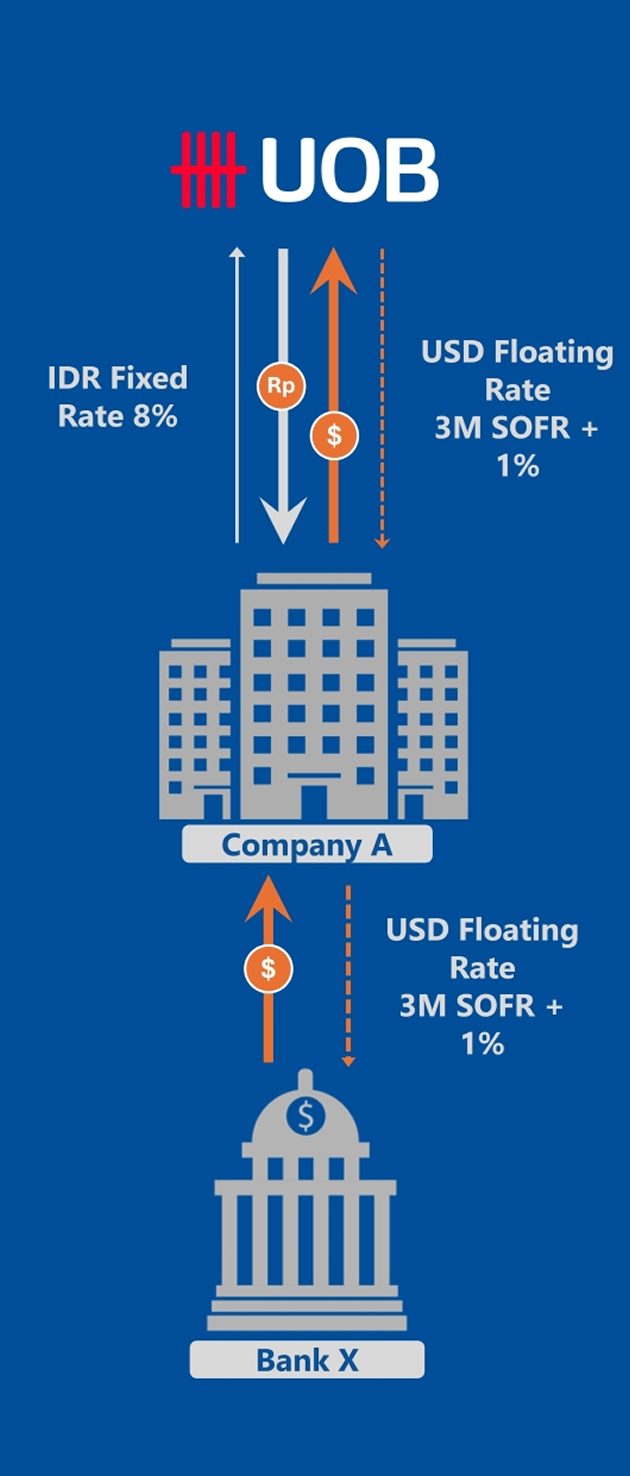
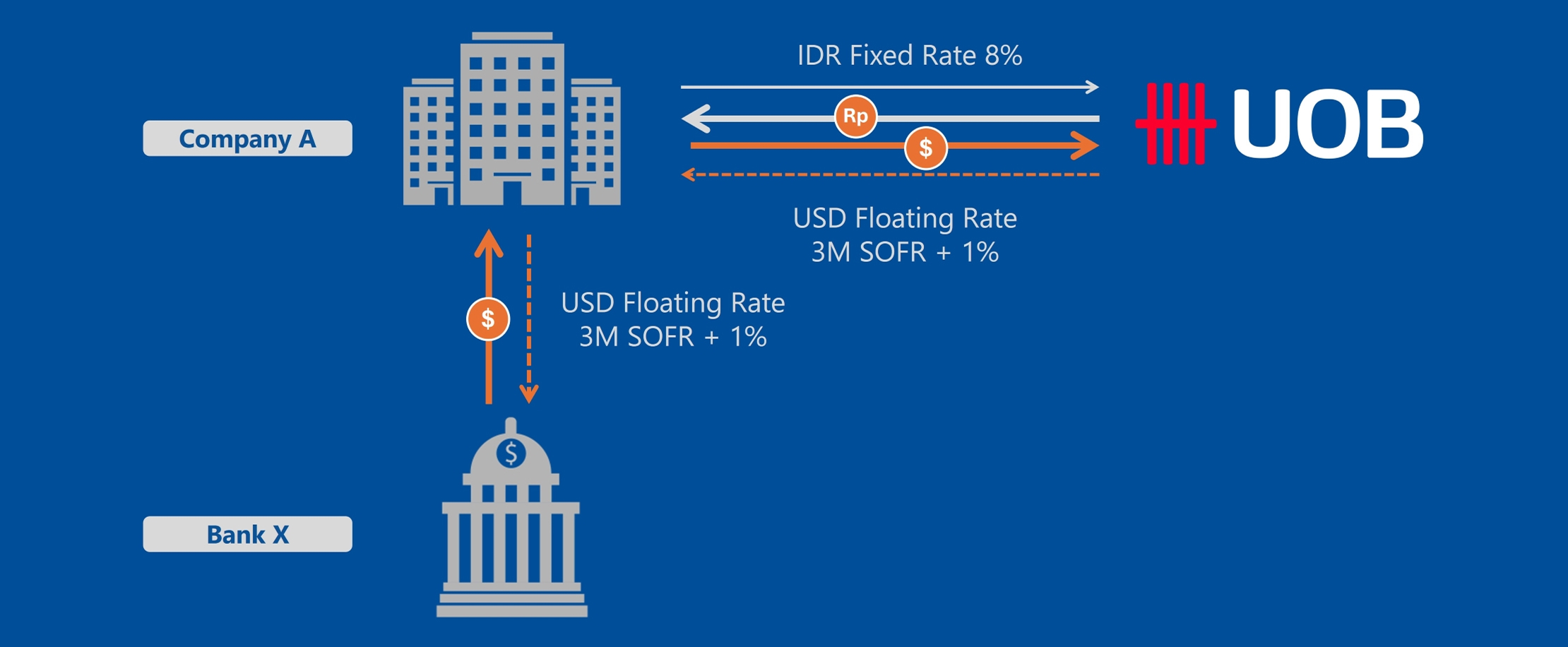
Scenario
A company has obtained a USD-denominated floating-rate loan but generates most of its revenue in IDR. This exposes the company to fluctuations in both exchange rates and USD interest rates, which may affect its financing costs.- The company exchanges the USD principal for an equivalent amount of IDR principal with UOB Indonesia using the agreed exchange rate.
- This allows the company to obtain IDR funding while maintaining its underlying USD financing.
- The company pays a fixed interest rate in IDR to UOB Indonesia.
- In return, the company receives a floating interest rate in USD (for example, 3M SOFR + 1%).
- The USD floating interest received helps offset the USD floating interest payable on the underlying loan, while the IDR fixed interest provides greater certainty over financing costs.
- The company and UOB Indonesia re-exchange the original principal amounts using the same exchange rate agreed at the start of the transaction.
- This eliminates uncertainty over the exchange rate applicable to the principal repayment at maturity.
Through the Cross Currency Swap, the company effectively converts its USD floating-rate financing into an IDR fixed-rate obligation, helping to manage both foreign exchange and interest rate exposures while aligning its financing obligations with its operating cash flows.
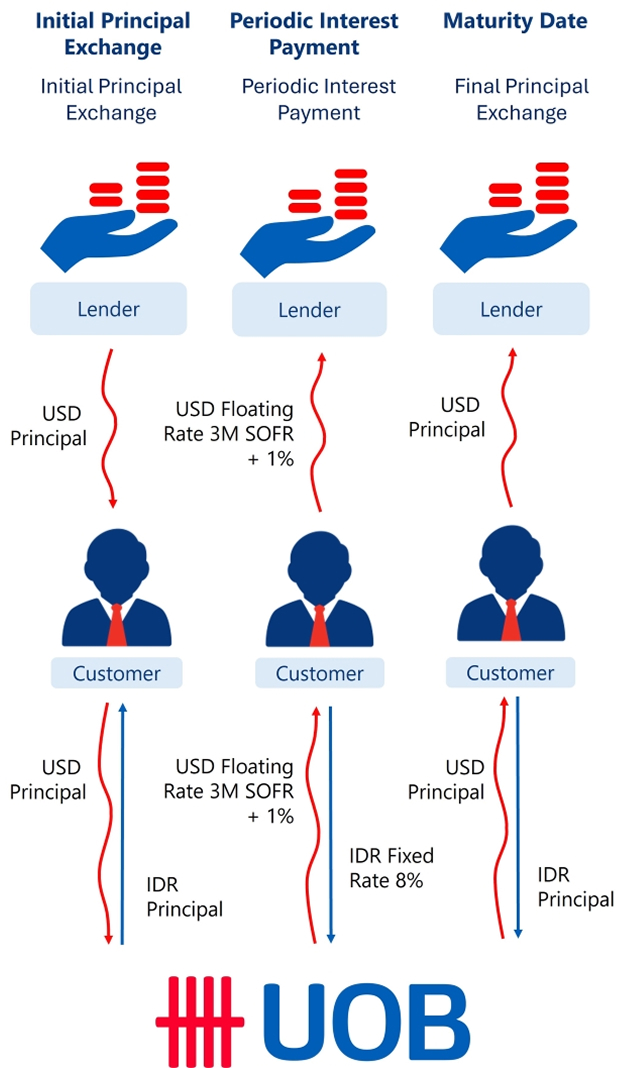
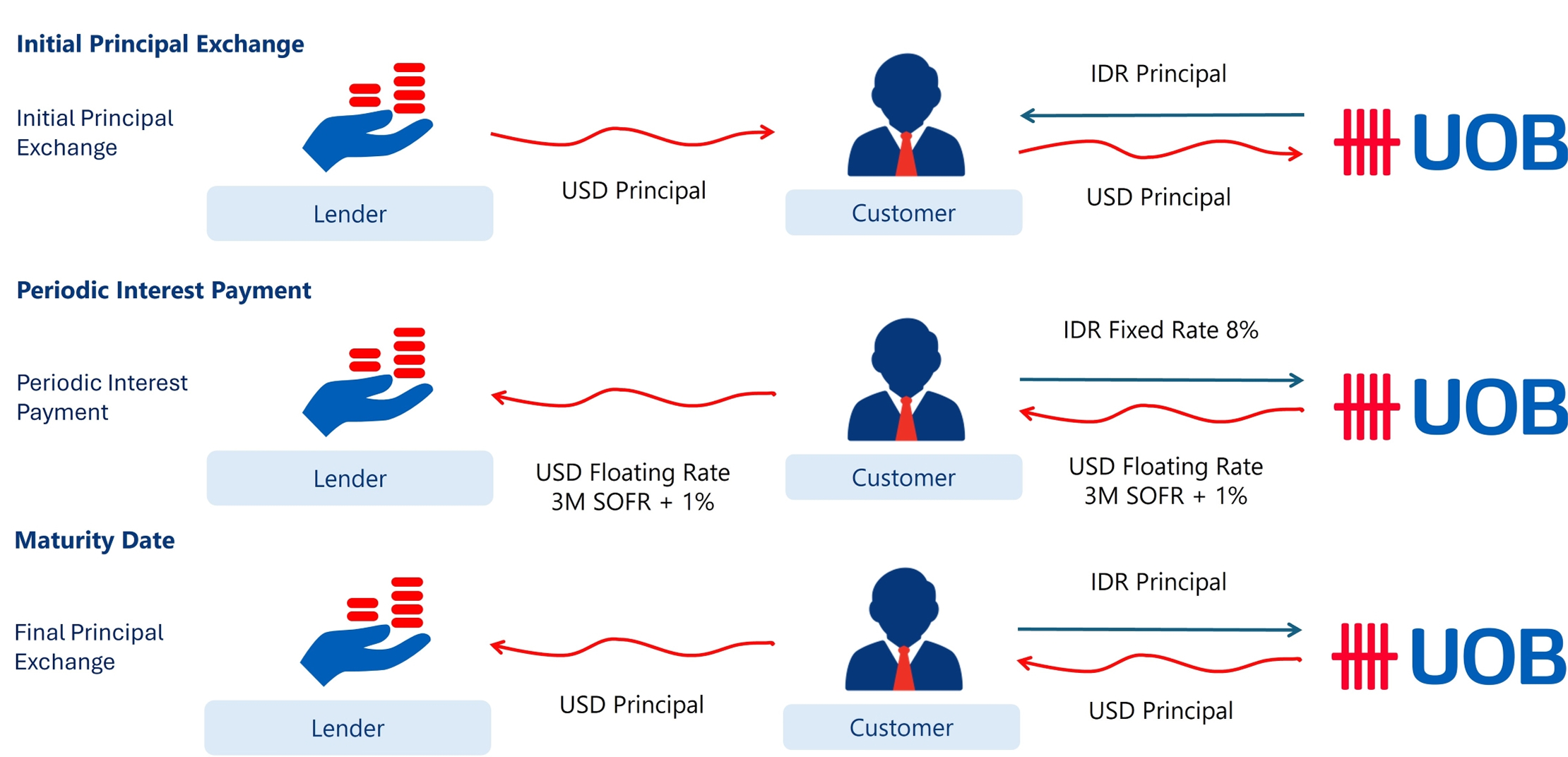
Note: This illustration is provided for explanatory purposes only. Actual transaction terms, interest rates and settlement amounts will depend on the Customer’s requirements and prevailing market conditions.
Fees
Under normal circumstances, no transaction fees apply.Frequently asked questions
What is a Cross Currency Swap?

A Cross Currency Swap (CCS) is a derivative transaction that allows two parties to exchange principal and interest payments in different currencies over an agreed period. It is commonly used to manage foreign exchange and interest rate exposures arising from cross-border financing or investments.
Who can use a Cross Currency Swap?
Cross Currency Swaps may be suitable for businesses Customers with underlying foreign currency financing or investment exposures who wish to manage foreign exchange and interest rate risks, subject to the Bank’s eligibility requirements and applicable regulations. Customers are required to satisfy the specific regulatory criteria, including maintaining a banking relationship with UOB Indonesia and providing supporting documents for the Bank's assessment prior to entering into the transaction.
Does a Cross Currency Swap eliminate all foreign exchange and interest rate risks?
No. A Cross Currency Swap is designed to help manage identified foreign exchange and interest rate exposures, but it may not eliminate all financial risks. Customers should consider their overall financial objectives, underlying exposures, and other relevant risks before entering into a transaction.
What factors determine the pricing of a Cross Currency Swap?
The pricing of a Cross Currency Swap is determined by various market factors, including prevailing interest rates in each currency, exchange rates, market liquidity, the transaction tenor, and other relevant market conditions at the time the transaction is entered into.
Why would a business use a Cross Currency Swap instead of separate foreign exchange and interest rate hedging transactions?
A Cross Currency Swap enables a business to manage both foreign exchange risk and interest rate risk within a single transaction. This may provide a more efficient hedging solution for foreign currency financing or investments compared with entering into separate hedging transactions, depending on the customer’s objectives and market conditions.
Can the terms of a Cross Currency Swap be customised?
Yes. Subject to market conditions and the Bank’s approval, a Cross Currency Swap may be tailored to meet a Customer’s hedging requirements, including the currencies involved, amortisation, notional amount, tenor, interest rate structure, and payment frequency.
What happens if market exchange rates or interest rates change after entering into a Cross Currency Swap?
Changes in exchange rates and interest rates may affect the market value of the Cross Currency Swap but they do not affect the contractual payment obligations if the transaction is held until maturity, unless otherwise agreed by the parties.
Can a Cross Currency Swap be terminated before maturity?
Subject to agreement between the parties, a Cross Currency Swap may be terminated, cancelled, or unwound before its scheduled maturity. Depending on prevailing market conditions, this may result in additional costs.
You may also like

Interest Rate Swap
Manage interest rate exposure with UOB Indonesia’s Interest Rate Swap solutions.

Call Spread Option
Manage foreign exchange exposure with a flexible and cost-efficient hedging solution.

FX Options
Manage foreign exchange risk while maintaining flexibility.

We are here to help




Kami menggunakan cookie untuk meningkatkan dan menyesuaikan pengalaman penelusuran Anda. Anda dianggap telah menyetujui kebijakan cookie kami jika Anda melanjutkan untuk menjelajahi situs kami.

